Gender Role Reversal in The Miller's Tale
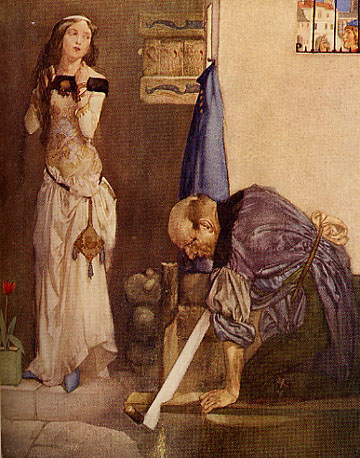
Gender Role Reversal in The Miller's Tale
To continue, although this was written in 1392, in the late Middle Ages, the character of Alisoun
seems to have the power that women of this time period did not easily have. According to Kathy
Lavezzo Alisoun showed independence and power in Miller’s Tale. This is expressed when
Lavezzo writes, “Not only is Alisoun unscathed by the close of the Miller’s Tale, she exhibits a
notable degree of agency… Alisoun’s prime moment of power occurs during the notorious
misdirected kiss sequence” (Lavezzo 8). This quote refers to the section in the Tale where she
rejects her male caller Absolon. Not only were women seen as objects at this time, but they also
had little to no say in who they were with romantically. Alisun fought this, in a very empowering
and masculine way. By making him kiss her arse in rejection, it exhibits a type of power that was
not typical of women in this time period. Giving his input Joseph Perry writes,
“As such a figure, on the other hand, Alisoun seems to generate, more than she affects,
the tale's plot, which nevertheless grants her a kind of power in the tale” (Perry 2).
This shows how Chaucer decided to give her power in this tale, that was not typically allotted to
females.
Furthermore, the gender roles seem to be reversed here since the Male characters are seemingly
the ones who are punished for adultery. In the Middle Ages, it was way more common that the
woman would more so suffer the consequences of adultery. This is because a man at this time
should have proper control over his wife. The male characters are Abolon, Nicholas, and John. In
the end, despite being cheated on by John the Carpenter is actually seen as a laughing stock of the
town. Absolon punished Nicholas, by sticking a hot stick up his rear, in reaction to Alisoun
punishing Absolon tricking him into kissing her rear. The dark humor and love triangle action
actually make these characters lose their masculinity in the end. Shannon Forbes writes about
Absolon’s lack of masculinity. This is seen when Forbes writes, “Perhaps most seriously, however,
Absolon fails to consistently enact the role of the courtly lover because he cannot successfully
execute his male authority over the female object of his love” (Forbes 5). Here Forbes suggests
that Alisouns’s power seems to stop Absolon from forcing Alisoun to love him.
To sum it up, by using these sources, this project will further prove that the gender roles are
reversed in Chaucer’s Miller’s Tale. This is due to the main points that Alisoun exhibits power that
women did not typically have in the Middle ages. The power Alisoun has with her choices and r
rejections causes the male characters to lose their masculinity. This is seen through their inability
to love her and their punishments for adultery. Therefore, the gender roles of the female and male
characters are swapped in Chaucer's Miller’s Tale.
Comments
Post a Comment